
God
Lazio
Video Games
Scripture
Faith
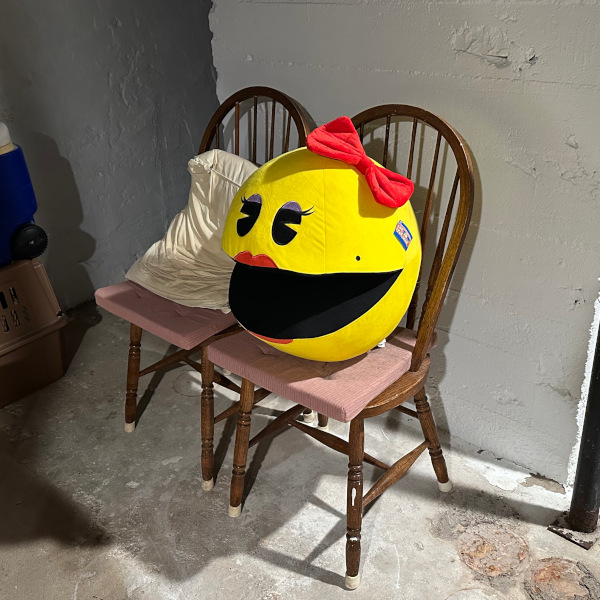
It was my forty-fifth birthday yesterday. This giant Ms. Pacman had been hanging from the ceiling in a store in the local mall for probably the past year, and every time I happened to be in the mall, the store would be closed. But, Ellyn and the kids surprised me with it is a gift:
Knighted
Perhaps Duncan can be my squire? I am now a member of the Fourth Degree in the Knights of Columbus, which is the "patriotic" degree! One interesting thing that I've observed is that although with our tiny human brains it's difficult to know the truth of a matter with too much certainty, a sure sign that one has picked up the trail-- like a detective's bloodhound-- is when multiple roads, originating from totally different sources, point to the same location.
Regular readers will know that I spent a couple of decades studying economics, politics, and social organization. That journey led me eventually to uppercase-L Libertarianism.
The formula for property ownership is different between Libertarians and Catholics: to a Libertarian the property is owned by whomever "homesteaded" it, i.e. put their labor into it and made some improvement to it. To a Catholic, God owns the property and we are simply temporary stewards, using that property to try to make saints of ourselves and others.
But the fundamental truth underpinning both of those views-- the gears in the clockwork which keep the models ticking-- is the same between the two groups: that the individual is sovereign, not subjected to other men. Chris Stefanick once made this video in which he explains that God has imbued us with human souls-- that far from being meaningless pieces of sand on an endless beach, we're "a Pretty Big Deal".
From Genesis 1:26:
To a Catholic, we are alone amongst creation to have a soul, and we are alone amongst creation to be made in God's image. Even though as a Libertarian I didn't frame things in terms of God, the above is exactly in line with how a Libertarian also thinks: their entire view of self-defense and self-sovereignty is based on the fact humans, alone among creation, can reason. If you lack the species-level capacity to express the will for self-defense, then you are not sovereign.
In other words, also to a Libertarian you're "a Pretty Big Deal"-- unique among the creatures. A squirrel, by contrast, lacks the capacity for reason; for self-reflection; and so is subjected to man. To a Catholic, a squirrel lacks a human soul-- reaching the same conclusion: it is subjected to man!
To a Libertarian, Free Will-- including freedom of association-- is sacrosanct. Provided someone isn't preventing someone else's exercise of Free Will (i.e. aggression), they are free to do as they choose.
To Catholics, the exact same is true. God loved us to much that He instilled us with Free Will, so we could choose him. As love is a voluntary reciprocal act, forcefully stopping someone else from exercising their Free Will is to rob them of their testimony-- provided of course they aren't acting in aggression towards someone else.
Once again: different paths to get there, but identical conclusions.
Although the United States Founding Fathers were more Minarchist than Ancap, the Declaration of Independence and the Bill of Rights are extremely libertarian (little-l) documents. Tying this back in to the Knights of Columbus then, the Fourth Degree presentation and exemplification lived right in the "Venn diagram" overlap of Catholicism and Libertarianism, really driving home the relationship between the Faith and American patriotism.
It turns out, that overlapping section of the diagram is even larger than I'd heretofore thought.
Rogue
One of the secondary sources I used for my most recent paper was the latest in a series of writers I've encountered lately which have a sort of flippancy about them, which I think is in error. Really, I think it's fundamentally a product of ego. When Pope Leo I explained that Eutyches was not humble enough to admit that perhaps there were wiser men than he, it wasn't a statement of arrogance on St. Leo's part-- it was an observation rooted in fact.
If I read Scripture then came up to you and said, "Actually, I don't think Mary is the Mother of God", or "I don't think Jesus had a divine nature", or "I don't think the Holy Spirit is part of the Trinity", you would be very justifiable in replying, "You do realize that these are all settled questions already, right? Do you not think the very Holy Spirit you bring into doubt had the winning hand in our understanding of these matters?"
It's good to be intellectually curious-- but with humility. To explore the mine, but without setting off dynamite and collapsing the whole structure, which is counterproductive as it leads us to bizarre conclusions. I could describe the notion as something like, "Growing comprehension, but with guard rails." Whereas this author I was reading, and others like him, treat things so casually! There are no guard rails: everything is up for grabs by the author, based on his own conclusions.
There is that famous Chesterton quote about tradition being the "democracy of the dead", and I think there is a certain checking of the ego which needs to take place, especially when studying subjects related to the Faith. There should be this acknowledgement that people far smarter than us have already hashed these fundamental questions out, and that God's Divine Providence was involved-- that it's good to study and understand the teachings, but to also not go our own and dive our car headlong off the cliff.
And that's not even touching on the concepts of Apostolic Authority with regards to teaching!
Lazio Setup
To end on a lighter note, this video is an awesome breakdown of how Gattuso's Lazio play. I've seen every minute of this season, and in every single game, no matter who we are playing, the opposition is constantly in a state of frustration. I had wondered how this was mechanically possible, and the author of this video breaks it down in great detail!
It was initially surprising to me that this Lazio has less verticalizations than Sarri's team from last year, given that team looked like they could play for four hours without creating a single goal chance. But after watching this analysis, I can see how both are true-- verticalizations and possession do not necessarily equate to goal scoring chances.
Knighted
Perhaps Duncan can be my squire? I am now a member of the Fourth Degree in the Knights of Columbus, which is the "patriotic" degree! One interesting thing that I've observed is that although with our tiny human brains it's difficult to know the truth of a matter with too much certainty, a sure sign that one has picked up the trail-- like a detective's bloodhound-- is when multiple roads, originating from totally different sources, point to the same location.
Regular readers will know that I spent a couple of decades studying economics, politics, and social organization. That journey led me eventually to uppercase-L Libertarianism.
The formula for property ownership is different between Libertarians and Catholics: to a Libertarian the property is owned by whomever "homesteaded" it, i.e. put their labor into it and made some improvement to it. To a Catholic, God owns the property and we are simply temporary stewards, using that property to try to make saints of ourselves and others.
But the fundamental truth underpinning both of those views-- the gears in the clockwork which keep the models ticking-- is the same between the two groups: that the individual is sovereign, not subjected to other men. Chris Stefanick once made this video in which he explains that God has imbued us with human souls-- that far from being meaningless pieces of sand on an endless beach, we're "a Pretty Big Deal".
From Genesis 1:26:
"Then God said, 'Let us make humankind in our image, according to our likeness; and let them have dominion over the fish of the sea, and over the birds of the air, and over the cattle, and over all the wild animals of the earth, and over every creeping thing that creeps upon the earth.'"
To a Catholic, we are alone amongst creation to have a soul, and we are alone amongst creation to be made in God's image. Even though as a Libertarian I didn't frame things in terms of God, the above is exactly in line with how a Libertarian also thinks: their entire view of self-defense and self-sovereignty is based on the fact humans, alone among creation, can reason. If you lack the species-level capacity to express the will for self-defense, then you are not sovereign.
In other words, also to a Libertarian you're "a Pretty Big Deal"-- unique among the creatures. A squirrel, by contrast, lacks the capacity for reason; for self-reflection; and so is subjected to man. To a Catholic, a squirrel lacks a human soul-- reaching the same conclusion: it is subjected to man!
To a Libertarian, Free Will-- including freedom of association-- is sacrosanct. Provided someone isn't preventing someone else's exercise of Free Will (i.e. aggression), they are free to do as they choose.
To Catholics, the exact same is true. God loved us to much that He instilled us with Free Will, so we could choose him. As love is a voluntary reciprocal act, forcefully stopping someone else from exercising their Free Will is to rob them of their testimony-- provided of course they aren't acting in aggression towards someone else.
Once again: different paths to get there, but identical conclusions.
Although the United States Founding Fathers were more Minarchist than Ancap, the Declaration of Independence and the Bill of Rights are extremely libertarian (little-l) documents. Tying this back in to the Knights of Columbus then, the Fourth Degree presentation and exemplification lived right in the "Venn diagram" overlap of Catholicism and Libertarianism, really driving home the relationship between the Faith and American patriotism.
It turns out, that overlapping section of the diagram is even larger than I'd heretofore thought.
Rogue
One of the secondary sources I used for my most recent paper was the latest in a series of writers I've encountered lately which have a sort of flippancy about them, which I think is in error. Really, I think it's fundamentally a product of ego. When Pope Leo I explained that Eutyches was not humble enough to admit that perhaps there were wiser men than he, it wasn't a statement of arrogance on St. Leo's part-- it was an observation rooted in fact.
If I read Scripture then came up to you and said, "Actually, I don't think Mary is the Mother of God", or "I don't think Jesus had a divine nature", or "I don't think the Holy Spirit is part of the Trinity", you would be very justifiable in replying, "You do realize that these are all settled questions already, right? Do you not think the very Holy Spirit you bring into doubt had the winning hand in our understanding of these matters?"
It's good to be intellectually curious-- but with humility. To explore the mine, but without setting off dynamite and collapsing the whole structure, which is counterproductive as it leads us to bizarre conclusions. I could describe the notion as something like, "Growing comprehension, but with guard rails." Whereas this author I was reading, and others like him, treat things so casually! There are no guard rails: everything is up for grabs by the author, based on his own conclusions.
There is that famous Chesterton quote about tradition being the "democracy of the dead", and I think there is a certain checking of the ego which needs to take place, especially when studying subjects related to the Faith. There should be this acknowledgement that people far smarter than us have already hashed these fundamental questions out, and that God's Divine Providence was involved-- that it's good to study and understand the teachings, but to also not go our own and dive our car headlong off the cliff.
And that's not even touching on the concepts of Apostolic Authority with regards to teaching!
Lazio Setup
To end on a lighter note, this video is an awesome breakdown of how Gattuso's Lazio play. I've seen every minute of this season, and in every single game, no matter who we are playing, the opposition is constantly in a state of frustration. I had wondered how this was mechanically possible, and the author of this video breaks it down in great detail!
It was initially surprising to me that this Lazio has less verticalizations than Sarri's team from last year, given that team looked like they could play for four hours without creating a single goal chance. But after watching this analysis, I can see how both are true-- verticalizations and possession do not necessarily equate to goal scoring chances.